LKP: On the U.S. and Israel's criminal, terroristic war of aggression against Iran
Pao Ching-ming, for the Linángan
13 March 2026
Jump to statement proper.
The Linángan ng Kultúrang Pilipíno (Institute of Filipino Culture) is an independent antiïmperialist cultural research institute, of which I have been a member since March 2025 (or thereabouts). Our work includes both theoretico-critical analyses and practico-political interventions; see, for example, the Karl Marx Festival last April, featuring discussions on both Marxist classics and contemporary Philippine culture, academia and the arts (with workers, partisan academics and long-time organisers); "A U.S. media deep-dive: How Iraq war tropes are being rehashed for Iran"; January's Pagtindíg at Paglában sa Imperyalístang Gérang U.S. (Standing and Struggling against U.S. Imperialist War); and our numerous meetings, fora, demonstrations and other consciousness-raising, solidarity-building engagements with fellow cultural organisations, cultural workers and Filipinos at large. My own research on semifeudalism (still ongoing after one whole year) is technically an LKP project.
When, where and how LKP was founded remains obscure to us—our best guess, in answer to the first question at least, is that its first members (including people from the film industry, one of whom was Lino Brocka's assistant producer/director, I'm not sure which) got together probably sometime in the 2000s. At any rate, after a long, long stretch of organisational inactivity it was revived in early 2025; I joined shortly after. It was the best decision I had made that year. LKP introduced me to organised life, the comrades and friends I've made there have taught me so much, and seeing as there's still so much more for me to learn and still such a long way to go, I think I'm here for the long haul.
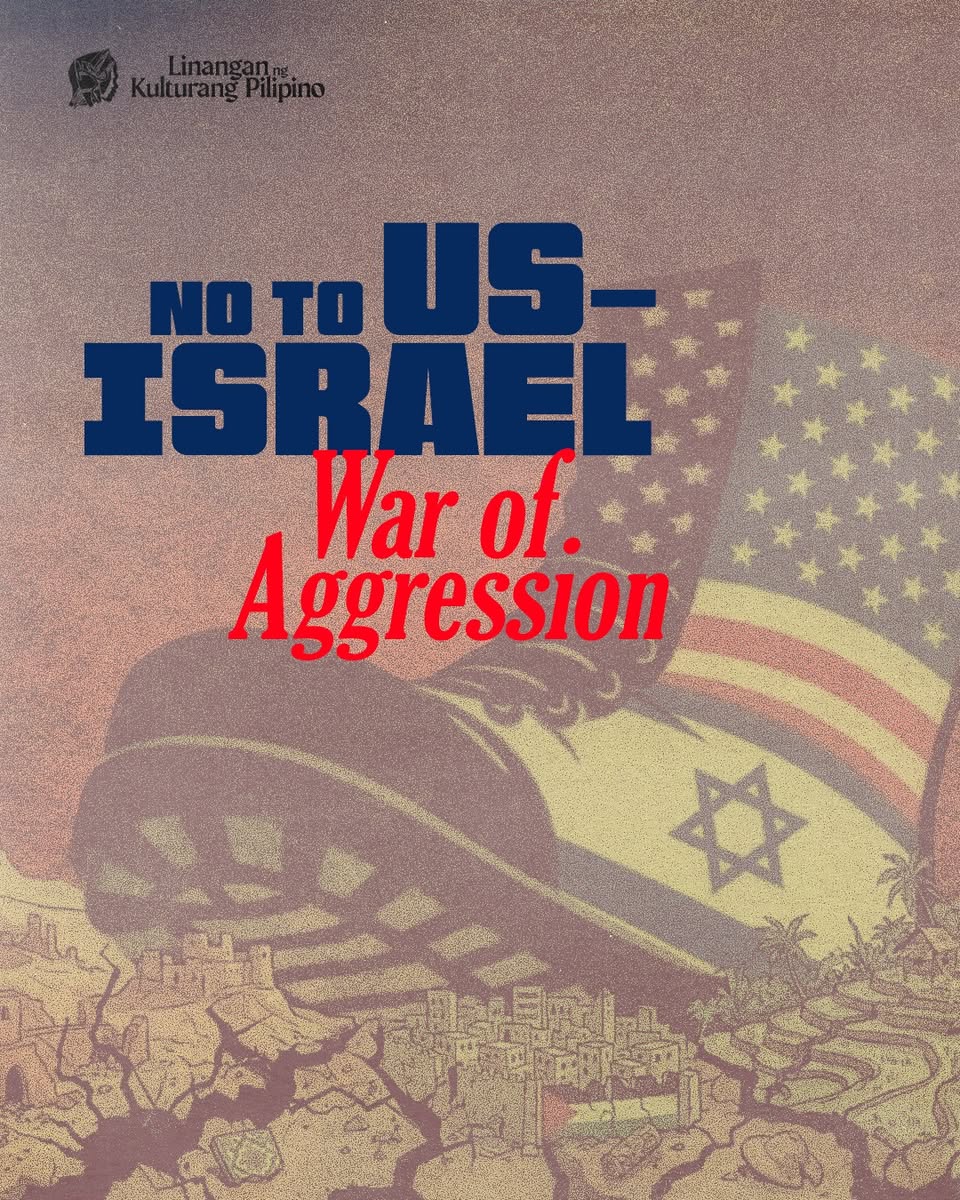
As regards the statement, I started work on it on or the day after the U.S. and Israel launched their campaign of fascist expansionism against the Islamic Republic, on 28 February. It took three or four days to finish due to school, &c., &c., and that was only the text; the graphics were another thing entirely. Still, I think the basic message is still very relevant and I'm happy it's finally out. Thanks are to Pao L., Andrea and to my other comrades at LKP for the graphics and editing. The original posts are on Facebook and Instagram; the graphics in JPEG format are here. If you're Filipino, concerned, a cultural/academic worker and/or interested in volunteering with us, you can sign up using this form.
Pao Ching-ming
15th March, 2026
* * *
The Linángan ng Kultúrang Pilipíno (LKP) unequivocally and without reservation condemns the United States and Israel’s war of aggression against the Islamic Republic of Iran.
Not only are the attacks completely unprovoked, unilateral, and in flagrant contravention of every stricture of international law, they also constitute mass murder on a national scale, the object of which seems to be the reduction of Iran to a neocolony or puppet state, if not its total annihilation. One bombing run, on a girl’s school in Minab, southern Iran, has already killed 148 schoolchildren and counting. Faced with national destruction and the abrogation of their sovereignty, LKP stands with the Iranian people in full solidarity as they defend themselves, their families and their right as a people to self-determination.
As well, we stand with the millions of Filipino migrant workers in the Middle East whose lives are under threat from U.S.-Israeli terrorism, and invite them, alongside Filipinos everywhere, to join us in critically taking stock of the situation and assessing our urgent tasks.
For us at LKP, it is clear that this latest assault is part of a broader strategy on the part of U.S. imperialism, with Israel as its proxy and chief outpost in the Middle East, to arrest its terminal decline and reassert itself as the global hegemon. When Trump rebranded the Department of Defence to the ‘Department of War’ last September, he was making a clear statement to the world: as his ‘war secretary’ Peter Hegseth said, ‘We’re going to go on offence, not just on defence. Maximum lethality, not tepid legality. Violent effect, not politically correct.’
Finding itself in a geopolitical landscape where Russia is able to sustain a war of expansionism right on Europe’s doorstep and where the world’s largest economy (by purchasing-power parity) and a third of its manufacturing is in China, and confronted by ever-falling rates of profit, always-rising rates of unemployment and graver and graver social crises by the second, U.S. imperialism’s response is simple: aggressive, America-first protectionism, mass-murderous foreign policy and the exportation of fascism worldwide.
Thus, the U.S. attacked Venezuela, an independent republic with oil reserves bigger than Saudi Arabia’s, and abducted its president, Nicolás Maduro, in a brutal display of imperial impunity. It has intensified efforts to starve the Cuban people into submission by way of sanctions; the six-decade embargo against Cuba, the longest in modern history, has been described as genocidal, as ‘economic asphyxiation.’ And of course, there are the Palestinians, the complete and total extermination of whom has been an official goal of Israeli policy ever since that noncountry was founded. A testament to its success so far, this January, Trump unveiled plans to build a ‘New Gaza’ and a ‘New Rafah,’ centred on tourism, real estate, export-oriented industries and so many other extraction jobs long familiar to any Third-Worlder.
A full fifth of the world’s oil consumption goes through the Strait of Hormuz, and it is from there that China gets half its crude oil. Iran shares a coastline with the strait, and has besides 13 per cent of global oil reserves. It being bombed by the U.S. and Israel is not at all unexpected. In fact, it is more than predictable. It follows 47 years of Iranian resistance against U.S. intervention, and, more immediately, negotiations concerning nuclear proliferation in which Iranian authorities have consistently adopted a conciliatory attitude. While the U.S. and the Zionist entity continue to push, with utmost force, the idea that Iran is some existential threat to peace and stability in the Middle East, the United Nations’s own nuclear watchdog, the International Atomic Energy Agency, maintains that there is no solid evidence to suggest that Iranian nuclear work goes beyond civilian purposes. It may be recalled that they used the same bogey against Saddam Hussein, and that in the aftermath of the campaign to confiscate his spectral, never-existent weapons of mass destruction, 600,000 Iraqis lay dead.
However the situation in Iran turns out, the Marcos régime will be complicit. Actually, it already is, and in the most direct way possible: before it was deployed to the Middle East, the USS Abraham Lincoln was stationed in the Philippines first. Here, in the South China Sea, it performed live-fire drills over the course of at least two weeks, likely as a response to Beijing’s own operations the month prior, dubbed ‘Justice Mission 2025.’ As tensions rose in Iran and Trump threatened the Iranian state anew, the aircraft carrier was redeployed. This was January; little over a month later, it was struck by four missiles from the Islamic Revolutionary Guard Corps (IRGC) in retaliation for the murder of Supreme Leader Ali Khamenei.
It doesn’t stop there, of course. Under the Enhanced Defence Coöperation Agreement (EDCA) with the U.S., the Philippines is effectively nothing more than a pitstop for U.S. forces and a launching pad for war with China. From big, conspicuous military bases like Clark and Subic before the ‘Magnificent Twelve,’ U.S. imperialism has moved towards subtler stratagems—like the ‘lily pad’ scheme, first thought up during the second Bush administration, which emphasises ‘smaller and less visible “coöperative security locations,” prepositioned supplies and Special Forces operations.’ Since then, numerous lily-pad bases have been built and continue to be built all across Africa, Europe, Latin America, West Asia and, naturally, the Philippines. Mainstream Philippine historiography can continue to claim that 1991 was the year national sovereignty was finally realised in full, that Tañada had won his anti-bases crusade, that now we truly are in times postcolonial, for in the P.I. there are no more bases—only lily pads!
As a strategy, the lily pads are ingenious insofar as they localise, to a degree the old-type bases could not, the violence of intervention. Gone are the days when U.S. soldiers were expected to remain within the bounds of U.S. military bases; now, thanks to the EDCA, the Philippine government is actually under mandate to ‘assist in facilitating transit or temporary access by United States forces to public land and facilities (including roads, ports and airfields), including those owned or controlled by local governments, and to other lands and facilities’ (Art. III, Sec. 2). Everywhere U.S. forces go, and this is as true everywhere as it is here, people lose their livelihoods and get their rights violated. This is not new, of course; what is new, or relatively new (the EDCA was signed in 2014), is the formalised scope of what they can get away with and where, as well as who pays for it.
For under the EDCA, imperialist occupation comes literally rent-free. Says Art. III, Sec. 3, ‘the Philippines shall make Agreed Locations’—the lily-pad bases—‘available to United States forces without rental or similar costs.’ While they do qualify that with ‘United States forces shall cover their necessary operational expenses,’ it must be noted that, four articles later, the U.S. is granted tax-free use of ‘water, electricity, and other public utilities.’ ‘Taxes and similar fees’ are to be charged to the Philippine government, which is to say, naturally, to the Filipino people.
And what do they get in exchange for all these privileges, for this carte blanche free of charge? Nothing! Though the ‘agreed locations’ are the Philippine government’s on paper, in reality it is the U.S. that gets to decide when it can access them based on obscure ‘operational safety and security requirements.’ Neither does the Philippines have any say in what goes in or out of these locations, be those nuclear armaments, biological weapons or God knows what else, for as the agreement sets out, ‘United States forces and United States contractors shall have unimpeded access to Agreed Locations for all matters relating to the prepositioning and storage of defense equipment, supplies, and materiel’ (Art. IV, Sec. IV). Notice particularly the use of ‘contractors’: in the imperialised Philippines, private entities owned by private citizens of the U.S. exercise as much, if not more, power and authority than the state itself.
All these outrages and more are justified ‘given the mutuality of benefits’ (Art. III, Sec. 3). One is therefore compelled to ask: What benefits? Iran has declared, with good reason, that countries hosting U.S. military assets constitute a valid target for attack. The U.S.-aligned petro-states of the Gulf have already been subject to bombings and strikes. One strike, on the United Arab Emirates, resulted in the death of one Pakistani migrant; another, on Tel Aviv, killed a Filipino. Clearly, other nations do not share the classically Filipino reverence for the letter of the law, for the law as its letter, the law in its most superficial form; where the U.P.-educated politico sees an ‘agreed location,’ the foreign statesman—possibly Iranian, possibly Chinese—sees a naval base, a weapons depot, a munitions factory, a legitimate military objective.
Tragically, it happens that the supposed identity of interests (and thus of consequences too) between the Philippines and the U.S. pushed for so long by our professional stooges in Congress and elsewhere does not, in fact, align with geospatial realities. America-proper has an entire ocean, the largest in the world, separating them from Chinese nukes and Chinese soldiers; the Philippines has what might as well be a puddle. Filipinos would do well to ask themselves: What price collaboration? Surely, after 130 years of revolution, nation-building and popular self-discovery, groping in half-darkness after the question ‘What is the Filipino?’, the answer cannot be ‘a sacrificial lamb.’
No, we at LKP hold that that cannot possibly be it. Therefore, we call on all concerned Filipinos to reject, repudiate and forever renounce the Marcos régime’s involvement, direct or indirect, in the U.S.’s terrorist war of aggression against Iran, as well as in its terrorist, imperialist activities across the globe.
We call on cultural workers in particular to combat any and all attempts to inveigle the public into supporting the subjugation of a sovereign people, and to amplify popular demands for an end to the EDCA, the total withdrawal of U.S. forces from the Philippines and the abrogation of all unequal treaties, clarifying the very real, very material necessity for antiïmperialist action and antiïmperialist solidarity. We call on them to take a principled stand against the imperialist offensive in culture, academia and the arts, and to consistently push a consciously partisan culture which has for its basis the world’s peoples, toiling and oppressed, and for its object their all-round liberation.
Stop the U.S.-Israeli war of aggression against Iran!
Defend Iranian sovereignty!
Uphold the right of all peoples to self-determination!
Frustrate imperialist warmongering, fight imperialism!
Back to top.